
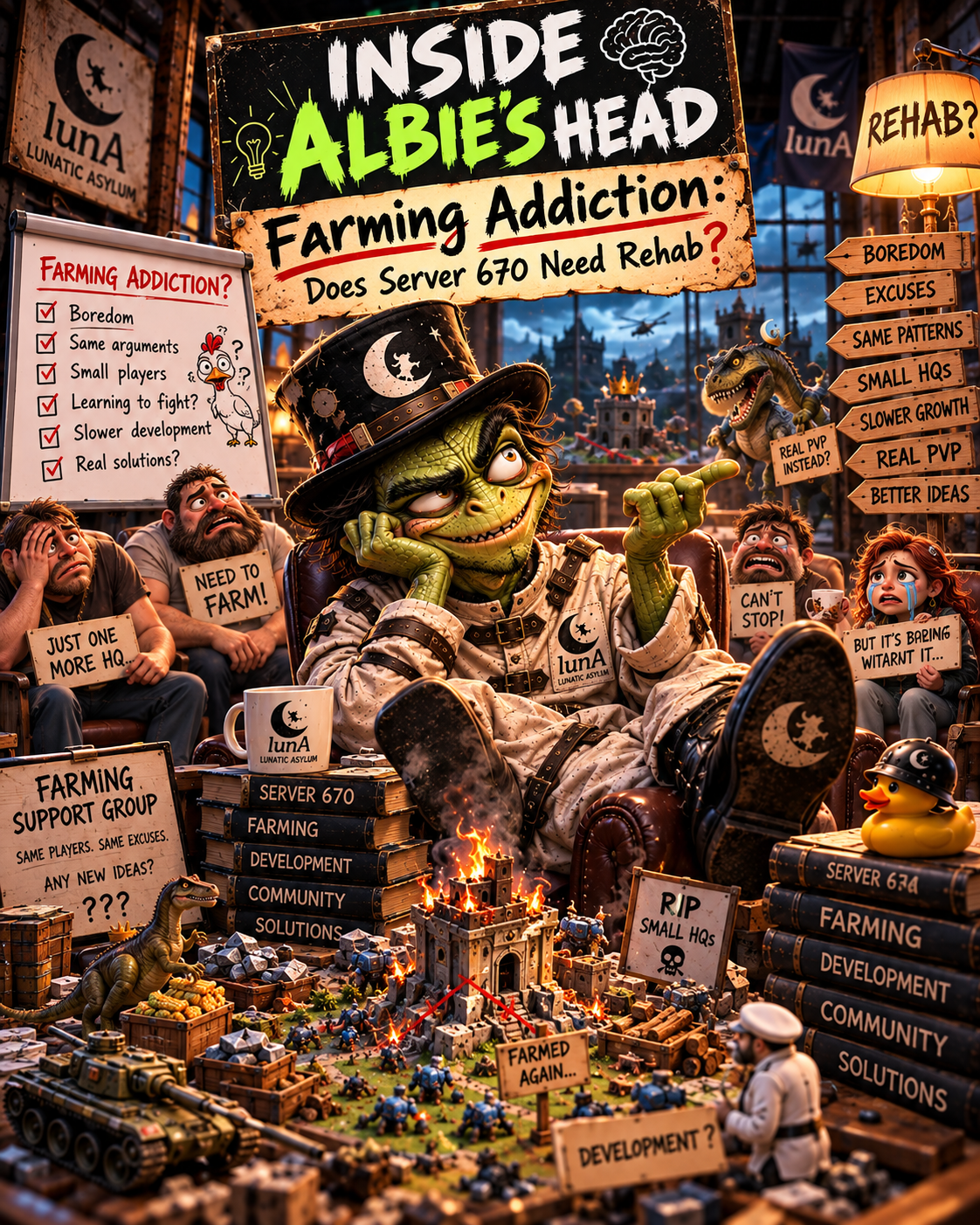
Inside Albie's Head – Farming Addiction: Does Server 670 Need Rehab?
Albie recently found himself sitting in another discussion in the R5 chat, and at some point, he started wondering whether he had accidentally walked into a support group for farming addicts. The atmosphere was remarkably similar to what he imagines a meeting of desperate junkies would look like. Everyone seemed absolutely convinced that they needed their next hit. Not tomorrow. Not next week. Now. Except instead of mysterious substances, the addiction involved attacking smaller headquarters and collecting resources. Apparently, going a few days without farming your own server is a medical emergency. Albie briefly considered suggesting a rehabilitation program, but he suspected that someone would immediately ask whether the rehab facility had any unshielded HQs nearby.
And once again, the same arguments appeared. The same explanations, the same justifications, the same desperate attempts to explain why farming our own server is absolutely essential to our survival. But Albie keeps returning to a rather inconvenient question: Does a successful server actually need to farm its own players? And if it does, why should an unsuccessful server like ours automatically follow the same strategy? Do we really have to copy everything other servers do? And if copying successful servers is the objective, why don’t we copy those that don’t farm their own people? Somehow, that particular example never seems quite as popular. Perhaps because it would require changing habits instead of defending them.
The first argument is usually boredom. Apparently, without the opportunity to set fire to a small HQ, life becomes unbearably dull. Albie can understand boredom. He’s spent enough time staring at construction timers to question the meaning of existence. But using the quiet period between seasons as evidence that the game desperately needs more internal farming seems a little questionable. Between seasons, of course things are quieter. That’s rather the point. And seriously, how exciting can it possibly be for a player with an enormous formation to flatten a low-level HQ? Where exactly is the challenge? The tactical brilliance? The heroic achievement? Congratulations, your 150-million-power formation defeated a headquarters whose strongest defensive weapon was probably a slightly irritated hamster. There have been suggestions for organized battles and tournaments between players of comparable strength. Actual fights, with opponents who can fight back. Imagine that! Albie finds that idea considerably more entertaining. But perhaps he’s simply too crazy to understand the extraordinary excitement of repeatedly kicking over the same small sandcastle.
Then comes Albie’s personal favorite: “The smaller players need to learn how to fight.” Ah yes. Education through repeated demolition. A fascinating teaching method. Apparently, having a smaller HQ automatically means you don’t know how to fight. Which is interesting, because Albie has seen plenty of smaller players who understand combat mechanics better than some of the big boys. During our last farming day, one particularly impressive example decided to send all four of his tanks into battle and promptly got burned. A beautiful demonstration of advanced military strategy. Naturally, Albie wondered whether the big players might actually be the ones who need more lessons. If farming smaller opponents is supposed to prepare us for SvS, perhaps we should first make sure the teachers understand the subject. Otherwise, our enemies might be in for a wonderful surprise when our mighty warriors arrive with four tanks and an optimistic attitude.
There’s another rather uncomfortable possibility nobody seems eager to discuss. Maybe some smaller HQs are still small precisely because they keep getting farmed. What a revolutionary thought! Perhaps repeatedly destroying someone’s troops, stealing their resources, and forcing them to spend on recovery isn’t the most efficient development program ever invented. Albie knows this might sound controversial, but slowing someone’s progress can occasionally result in that person progressing more slowly. Science is amazing.
And this is where Albie starts getting a little more serious, because he suspects some of our larger players have lost touch with what life is actually like at the bottom. They probably don’t remember having to spend valuable alliance points on shields instead of hero fragments. They don’t remember keeping their formations inside the HQ because they might need to defend or teleport at any moment. They don’t remember counting every speedup, every resource, and every little reward. And they certainly don’t remember what it’s like when your alliance doesn’t generate mountains of rewards every week. Albie notices that difference himself. When your alliance isn’t among the strongest, you don’t magically receive another 10,000 speedups just because you looked at the screen with sufficient determination. Recovery is harder. Development is harder. Everything takes longer.
Even something as simple as getting a hero fragment from a truck has become an adventure. Try finding a truck today that you can successfully attack with a 20-million-power formation. Good luck. Back when our heroes were driving those wonderfully ugly little cars, everyone was still developing. Even the stronger players weren’t that far ahead. The battlefield was a very different place. Today, showing up with less than 100 million formation power can feel like bringing a plastic spoon to a dinosaur fight. And when T10 troops and Destroyer EX enter the picture, that spoon suddenly seems even less promising. The gap between established players and newcomers is enormous, and pretending that everyone has the same opportunities is simply ridiculous. If we want smaller players to become useful fighters in SvS, perhaps helping them develop would be a more intelligent strategy than repeatedly setting them on fire.
The third argument is that farming is necessary for our own development. Without it, apparently, progress becomes impossible. Albie has some unfortunate news for the believers in this particular theory: he hasn’t been farming his own server for quite some time. He only farms on other servers on Saturdays, and somehow, through what must be an extraordinary violation of the laws of Last Z, he’s approaching HQ 33. His T10 research is somewhere around 50 percent, too. Is he the strongest player on Server 670? Certainly not. Is he completely hopeless compared to the server average? He doesn’t think so. Could he perhaps progress a little faster by constantly attacking his neighbors? Probably. But the fact remains that development without internal farming is entirely possible. And during Season 2, with all the available opportunities to collect resources, Albie would even go so far as to suggest that anyone who couldn’t find enough resources might want to reconsider their approach before declaring war on the neighborhood.
At lunA, we’ve also been trying something slightly unusual: organization. Dangerous concept, Albie knows. We coordinate our Resource Vaults so that as many members as possible can benefit. Every day at 16:00 APOC, we place one Wood Vault and one Food Vault. Members can use their two attacks according to what they actually need. And we’re preparing a second time slot designed to better accommodate our members in other time zones. Is it perfect? No. Does it solve every resource problem? Of course not. But it helps people develop without turning their own server into an all-you-can-eat buffet of burning headquarters. Sometimes cooperation can be surprisingly effective. Albie recommends trying it before dismissing the idea as witchcraft.
And then we reach the fourth argument. The one that makes Albie’s remaining brain cells pack their little suitcases and threaten to migrate.
“Small alliances don’t deserve protection because they refuse to merge and therefore don’t want to help the server in SvS.”
Seriously?
Of all the arguments Albie has heard, this one might deserve its own padded room.
Since when does choosing your friends mean refusing to help your server? Who decided that players must abandon the people they enjoy playing with simply because someone else believes their alliance is too small? And why are we automatically assuming that these people don’t WANT to contribute? Perhaps they would love to help. Perhaps nobody has made a serious effort to find a role that suits their capabilities. Not everyone needs to be a frontline fighter with a gigantic formation. There are other ways to contribute, and a server that genuinely wants to succeed should be looking for ways to involve its players instead of inventing reasons to punish them.
Yes, smaller alliances receive fewer rewards. Yes, they develop more slowly. Yes, merging into a larger alliance can offer practical advantages. Nobody is denying that. But who exactly gave us the authority to decide whom other people are allowed to play with? Albie has personal experience with this. At lunA, we’ve discovered that simply being powerful doesn’t mean people belong together. Sometimes personalities don’t fit. Sometimes expectations are different. Sometimes one group wants maximum rewards, maximum efficiency, and maximum power, while another group wants to laugh, help each other, and enjoy the game without turning every day into a performance review. Neither approach has to be forbidden. But forcing people into an environment they don’t enjoy, supposedly for the greater good of the server, seems like a remarkably effective way to make them quit altogether. Albie certainly knows which kind of alliance he’d rather be part of. If the only acceptable way to play were to chase power and rewards at the expense of everything else, he’d probably hang up his ridiculous hat and find something more entertaining to do.
And perhaps that’s the part that bothers him most. We keep talking about server strength as if it were nothing more than a collection of combat power numbers. But a server is made of people. People who log in because they enjoy the game, because they have friends, because they feel part of something. If we make life increasingly miserable for smaller players and smaller alliances, how exactly does that help us in the long run? Do we imagine that constantly being farmed will inspire them to become enthusiastic defenders of Server 670? That they’ll thank us for destroying their troops, emptying their resources, and slowing their development? “Thank you, mighty warrior, for teaching me the importance of buying another shield. I shall now dedicate my life to your SvS ambitions.” Albie has his doubts.
And no, before anyone starts sharpening their pitchforks, Albie isn’t suggesting that fighting should disappear from Last Z. It’s a war game (actually it’s just what people say as an argument but it’s a survival game). He likes battles. He likes competition. He likes watching a good fight, especially when both sides actually have a chance of winning. What he questions is the almost religious belief that we must repeatedly farm our own smaller players because that’s simply how things have always been done. There is a difference between fighting worthy opponents and treating your neighbors as renewable resource deposits. One requires strategy. The other mostly requires finding someone who forgot to buy a shield.
Which brings Albie to a rather uncomfortable conclusion about our own server. We keep saying that we want to improve. We discuss rules, protection, fairness, and cooperation. We talk about making Server 670 stronger and more attractive. But whenever someone suggests doing something genuinely different, we somehow end up returning to the same old habits. Why? Because they’re familiar? Because changing things would require effort? Because it’s easier to tell smaller players to adapt than to ask larger players to reconsider their behavior?
Albie is particularly disappointed because some players were attracted to our server by the promise that we wanted to do things differently. That we were trying to build something better. Something less toxic, more cooperative, and perhaps even a little more enjoyable. And now he worries that we’re already failing those expectations. Not because change is impossible, but because we seem reluctant to leave our comfort zone. We promise a different future and then reach for the same old rulebook. That’s a rather strange way to start a revolution.
Albie doesn’t need trophies to prove that he’s having a successful time in Last Z. He’s approaching HQ 33, making decent progress toward T10, and enjoying himself without treating every smaller HQ as a personal savings account. More importantly, he’s surrounded by wonderful people in lunA. People he cares about. People he wants to help grow. People who make him laugh, occasionally drive him completely insane, and give him a reason to keep logging in. For Albie, that’s worth more than another warehouse full of stolen wood.
So perhaps the question isn’t whether Server 670 can survive without farming its own smaller players. Perhaps the question is whether we have the courage to find out. To organize meaningful battles, create opportunities for smaller alliances, encourage cooperation, and stop confusing the ability to destroy something with the ability to build something better.
Albie doesn’t pretend to have every answer. Half the time, he’s lucky if he remembers why he opened a particular menu. But he does know one thing: if we genuinely want a stronger server, perhaps we should spend a little less time teaching our neighbors how to burn and a little more time helping them become strong enough to fight beside us.
And if the farming withdrawal symptoms become unbearable, Albie is willing to organize a support group.
He’ll bring cookies, a few comfortable straitjackets, and perhaps a nice little Resource Vault for everyone to stare at.
Just please don’t attack the building.
There are people inside.